HOFame: History, Mystery, Future, Part III
PART III — The Room before the Zoom
🏈🏈🏈🏈🏈🏈🏈🏈🏈🏈🏈 🏈
Editor’s note: This is Part 3 of a five-part series on the evolution of the Pro Football Hall of Fame, from concept to completion and through the years to the current status. Written by Frank Cooney, in his 33rd year on the Hall of Fame selection committee. We also provide unique research, analysis and data to complement this series
*Access the full HOFame Reference post here.
Hall of Football is not affiliated with the Pro Football Hall of Fame. All analysis and opinions expressed are solely those of Hall of Football (HallofFootball.substack.com).
🏈🏈🏈🏈🏈🏈🏈🏈🏈🏈🏈🏈🏈🏈
Before Covid and the Hall of Fame’s Selection Zoom meetings, The Room was always the process.
The Room.
Not the rules. Not the categories. Not the charts.
The Room.
For years, from the 1960s until COVID, the selection process had its own rhythm. Groups of selectors often met when there was an opportunity, such as at the Combine in Indy. There was constant exchange of ideas among selectors and between selectors and Hall executives. There was a bond, an unstated but understood common goal.
We knew each other and how to work together.
But the big meeting was Super Bowl Saturday — Selection Saturday — on location at the site of the game.
In The Room.
These were grueling, all-day scrimmages, which began with pastry and coffee at 7 a.m., broke for a quick box lunch at noonish and included eyeball-to-eyeball accountability. New selectors established credibility, bridged decades and other distances, with veterans. I was the youngest selector 33 years ago, and now I am one of the oldest.
I was in awe of some of the original selectors and great storytellers such as Will McDonough and John Steadman. These orators held court with impassioned presentations.
Yet there were notable differences in perspective. Some of those more veteran selectors carried concepts from earlier generations that may have outlived reality. The handling of at least two Hall of Famers-to-be stood out to me.
John Mackey, who raised the bar on tight end play from 1963 to 1972, waited 20 years (including mandatory five-year wait) before he was inducted into the Hall of Fame in 1992. Why? In light of discussions after the 2026 Class announcement one might wonder if Mackey was among the “most deserving” at least once during his wait.
Most popular guess is Mackey served as the first president of the National Football League Players Association (NFLPA) after the merger. His aggressive, effective, and often contentious advocacy for better pension, disability benefits, and free agency caused friction with NFL owners. Some selectors admitted later that they fed off that negativity.
Ken Easley, rated by Ronnie Lott as the best safety ever, waited 30 years to be inducted after serving as NFLPA rep during a contentious strike year. He was left out in the cold after a trade to Arizona was nixed when the Cardinals medical exam showed he needed a kidney transplant to live, let alone play. There was a law suit, a settlement but it took time an a new ownership before Easley was welcome back.
Easley lived ten years after his induction and was often at Canton enjoying his Gold Jacket experience.
If selectors are only supposed to consider what happens on the field, then the issues that hurt Mackey, Easley and others should not be part of the consideration.
Big if.
Another disparity — generational and probably more — occured in the early 90s when I suggested to fellow selectors we might consider the induction of wide receiver Art Powell.
The shocking response by a couple of veteran selectors included “we don’t want no uppity n-word in the Hall of Fame.”
I waited until I thought the atmosphere changed and advocated Powell for the 2024 class. He became a surprise finalist. But as somebody whose feats were decades before most selectors watched the game, he was treated like a distant rumor and fell short during the final up/down voting.
While I waited for the time to be right — during allegedly changing attitudes following the 2020 George Floyd incident — the memory of Powell’s feats faded into a forgotten corner of history. Most, almost all, selectors who saw him play were no longer around.
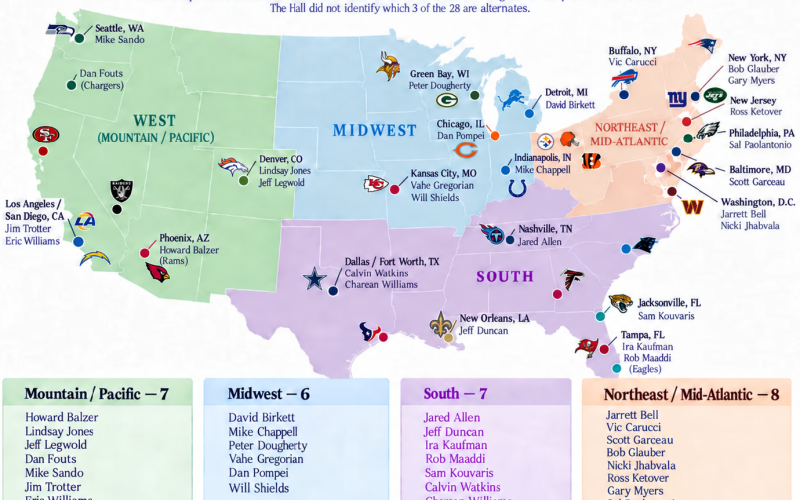
So, I find comfort in the veteran selectors who are closer to my age and experience, including Rick Gosselin, Ron Borges, Clark Judge, Howard Balzer, John McClain, Tony Grossi, Mike Chappell, Sam Kouvaris, Paul Domowitch, Jarrett Bell — and others.
We must keep their their experience, their first-hand knowledge of the game that goes back decades even as we juggle the recent fame of each new class.
This is what I mean by equitable selections.
🏈🏈🏈
Know the Hall of Fame Selectors:
Previously unpublished list of Hall of Fame Selectors — all of them since the first class. See the line of succession per franchise, years of service. A downloadable file. If you need help, email me at fcooney@sportsxchange.com
🏈🏈🏈
Through the years there were memorable Saturday battles in The Room.
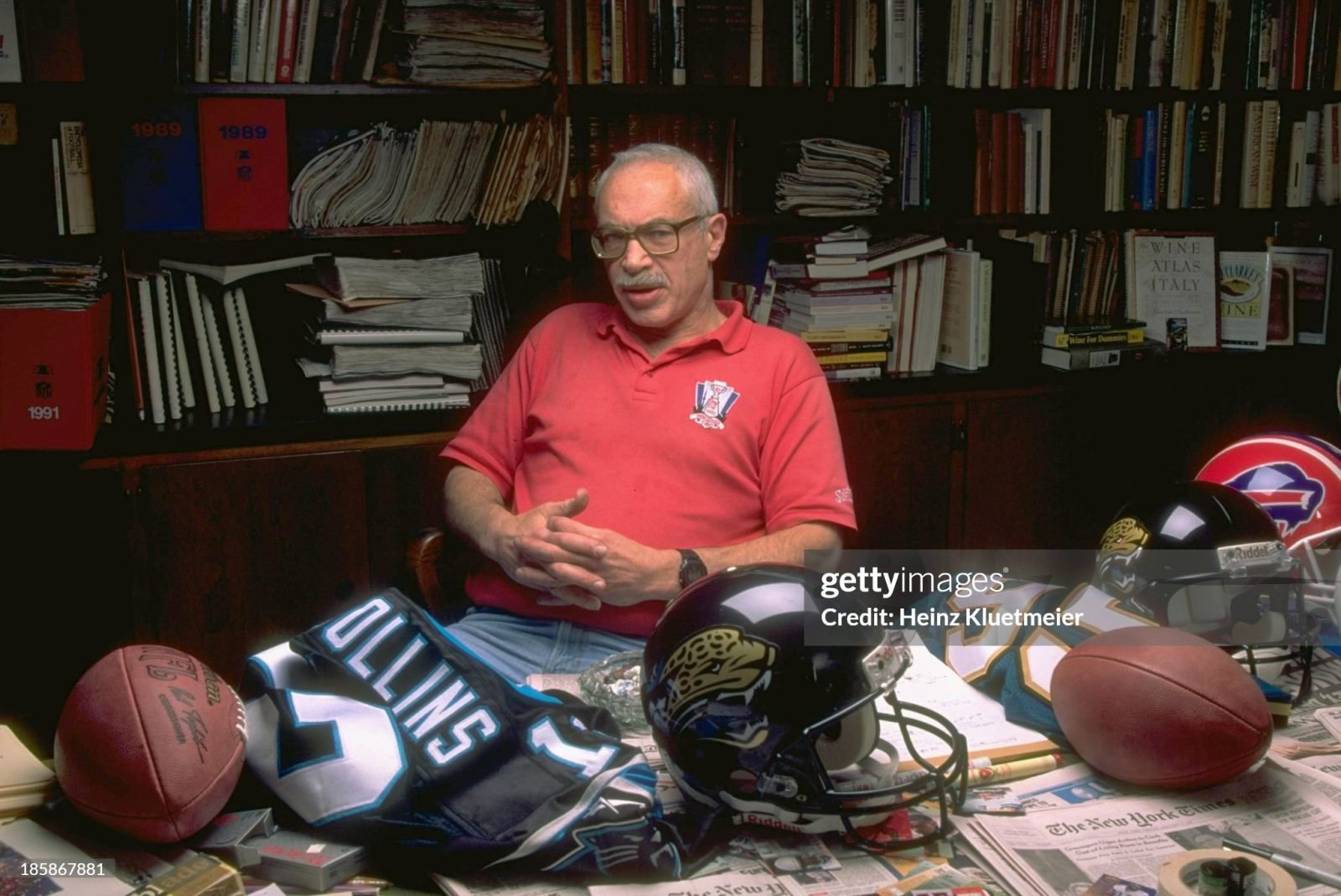
Former Sports Illustrated writer Paul Zimmerman — the late, great Dr. Z — carried a powerful voice for many years. Some say too powerful. That remains debatable. But nobody questioned his passion, and he did swing votes.
We became friends during the 1970s and 80s through our shared obsession with the draft, long before it became a national addiction. During spring owners meetings we spent hours in hotel business centers exchanging reports and intel on prospects.
But friendship was shelved during some selection meetings when we disagreed on candidates, especially Ken Stabler and John Madden. Those exchanges got ugly.
Then, after the meeting, we often had dinner with our wives. Zim invariably ordered expensive wine — and somehow convinced Sports Illustrated to pay for it.
One year Dallas receiver Bob Hayes failed to gain election as a senior finalist. Zimmerman stormed out furious because almost nobody spoke against Hayes during discussions.
“Silent assassins,” he barked. “Gutless silent assassins. That does it. I quit.”
A couple bottles of expensive wine later, Zim calmed down. A few years later Hayes was inducted.
The Room was not always smooth. It was not always polite.
But it worked.
There was accountability in The Room. Responsibility in The Room. When the process finally reached its conclusion, it usually carried a certain unanimity — even if some left muttering, “I’ll get him next year.”
One room. One decision. One reveal.
Over time, that changed.
Since COVID, selection meetings moved to Zoom. There were attempts to restore in-person meetings, but none fully took hold, although that possibility still exists for the 2027 Class. At the same time, the Hall wants to preserve “The Knock,” introduced during David Baker’s tenure.
Back then, finalists gathered at the Super Bowl hotel while Baker dramatically knocked on the doors of newly elected inductees before the live Saturday night, on-air announcement. At 6-9, ~400 pounds, Baker’s Knock was substantial.
Through the 2026 Class, voting occured remotely in January, then Hall representatives travel to the homes of future inductees to film surprise announcements in advance of the public reveal. The show was produced to air on Super Saturday. Everyone involved must keep the results secret. Selectors know the cutdowns to a point, but then wait with everybody else for the televised Thursday reveal. Even done well, the Saturday Knock show is anticlimactic.
Once a nice touch, “The Knock” may now introduce more of a problem than a payoff.
The process continues. The feel of it does not.
What once unfolded in one room, through one long day of debate and one final Saturday-night announcement, now stretches across distance, schedules and secrecy.
I know is is improbable they will return, but I still prefer the old Saturday battles, the arguments in person and the race to announce the class that same night.
The reveal is now part of the NFL’s Thursday Honors show, which features AP Player of the Year and a long list of other awards. It squeezes in the HOF reveal in a manner almost demeanting to the highest reward in the sport.
Surely the HOFame can fined a sponsor and venue for its own show that gives each inductee the respect he deserves.
Those Selection Saturdays we so dramatic. Everything felt bigger. More connected. More accountable.
🏈🏈🏈
Concern in The Room increasingly centered on accumulation.
Each year brought a new class of eligible players. Each year only a handful advanced. The ballot kept renewing itself while older candidates gradually drifted further from the center of discussion.
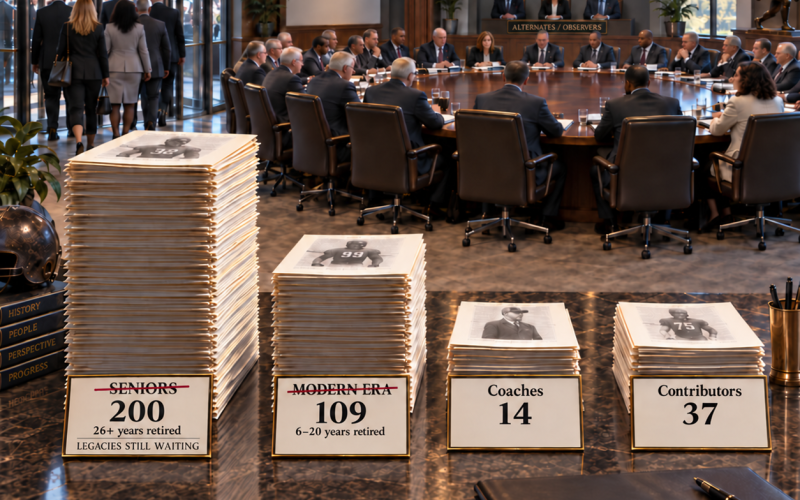
Over time, many Hall of Fame–caliber players disappeared from the process before ever reaching discussion in The Room.
Some selectors came to call it the Senior Abyss.
Candidates spent up to 20 years in the Modern-Era process. Yet once they slipped beyond the early years of eligibility, most lost momentum while being shoved along by the annual flood of newer names and fresher debates.
Guard Steve Wisniewski became the latest example after failing to gain election with the Class of 2026. An eight-time All-Pro and member of the NFL’s 1990s All-Decade Team, Wisniewski spent two decades in the Modern-Era process before falling into the senior pool without ever reaching the semifinalist stage required for discussion in The Room.
The pattern extends well beyond one player.
In the accompanying chart rating senior candidates by honors and awards across eras, 10 of the top 11 earned All-Decade recognition. None even reached discussion in The Room during 20 years as Modern-Era candidates.
Ironically, many of the same selectors who placed those players on NFL All-Decade teams never advanced them to discussion as Hall of Fame finalists.
Top-Rated Senior Hall of Fame Candidates Based on Honors and Awards
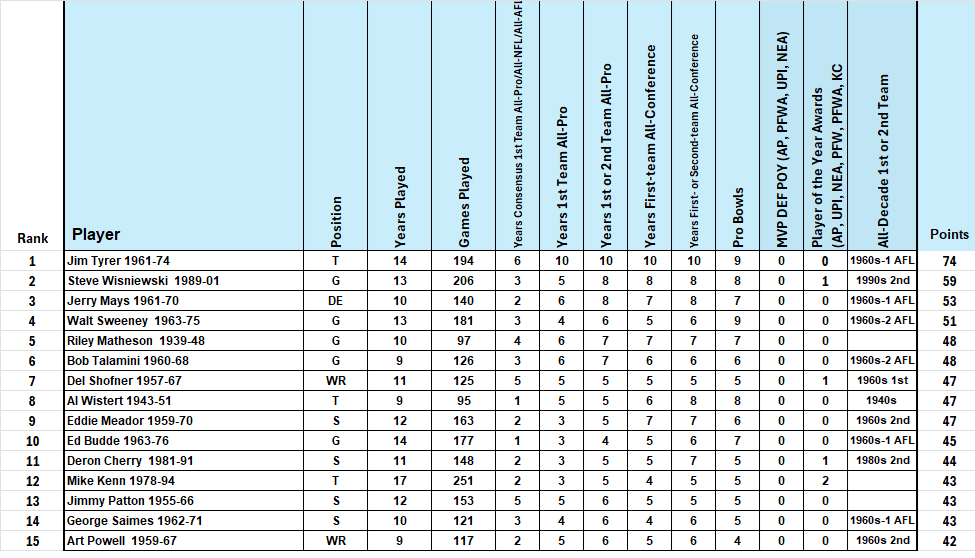
One look at this star-studded list and it become clear why most selectors dislike the Group of Five rule, which puts together three senior players, one coach and and one contributor, all nominated as finalists by their respective Blue Ribbon Selection committees.
The full Selection Committee receives three votes to use on that Group of Five, with 80 percent approval — 40 votes — required for election. In the two years that process existed, only one inductee advanced each time: seniors Sterling Sharpe and Roger Craig.
Selectors say the process is restrictive Hall execs hint the problem is with the selectors, not the process.
Meantime, in The Room, more contemporary candidates increasingly dominated debate.
Quarterback Eli Manning — a two-time Super Bowl MVP — became the subject of extended discussion during the 2025 and 2026 cycles despite never earning first- or second-team All-Pro honors during a 16-year career. Meanwhile, decorated senior candidates struggled even to reach semifinalist status.
Recent finalist lists tilted heavily toward first-, second- and third-year eligible candidates — players still close to their careers and fresh in the public consciousness.
The Hall’s own history reflects the trend.
Of the 329 players inducted through 2026, 137 — 41.6 percent — gained election within their first three years of eligibility. Only 21.6 percent entered through the senior process.
That imbalance does not correct itself over time.
It compounds.

The incoming 2027 class — players retiring after the 2021 season — tightens the cycle further.
The group includes Adrian Peterson, Rob Gronkowski, Ben Roethlisberger, Richard Sherman, Cam Newton, Andrew Whitworth and Antonio Brown.
Each arrival reshapes the ballot.
Each arrival pushes others back.
And there are more. Always more.
The new eligibles for the 2028 Class include quarterback Tom Brady, defensive end J. J. Watt, wide receiver A. J. Green and quarterback Matt Ryan.
The backlog does not shrink.
It rolls forward. It grows.
And The Room adjusts accordingly — spending time where momentum is strongest and arguments are most immediate.
The effect is not subtle.
It is structural.
Despite all the controversy and contention, The Room did not break in 2026.
It revealed itself.
Next: Part IV — “What changed?” he asked.
🏈🏈🏈🏈🏈🏈🏈🏈🏈🏈🏈 🏈
See unique downloadable chart of all Pro Football Hall of Fame inductees.
If you need help on downloads, email me at fcooney@sportsxchange.com