Canton Chaos: HOF Shrinks Instead of Thinks
See official lists: Committee cut in half, Seniors lose path to finals as Hall again rewrites selection process
Editor’s note: Click here to see updates. Watch for follow-up stories throughout the next week and beyond.
🏈🏈🏈🏈🏈🏈🏈🏈🏈
On Sept. 4, the Pro Football Hall of Fame announced another reconstruction of its selection process, continuing a series of significant and conflicting changes dating to 2022.
The selection committee will shrink from 50 to 25 members, with three additional nonvoting participants. The Hall eliminated the dedicated Seniors Committee and the Senior category itself, placing every eligible player into one pool regardless of if he played six or sixty years ago.
The haphazard rollout of the changes reflects a broader problem with dysfunctional administrating at the Hall and that’s not even considering process changes that are questionable at best.
Selectors were briefed by Hall president Jim Porter during a Zoom call Sept. 3 . The next morning, the Hall publicly announced the new 28-person structure even though the 50 selectors were not yet told whether they would remain part of it. The official release explained that the new slate would be announced only after all 50 members of the previous committee were notified of their status.
In the email distributing that embargoed release, selectors were told individual conversations would occur “in the coming days.”
A week later, on Sept. 11, two Hall administrators — neither of them Porter — attempted to contact all 50 selectors in a single day to tell each person whether he or she would remain on the committee and, in some cases, whether another role would be offered. One selector was out of the country and could not be contacted until a couple of days ago.
The effort produced exactly what might be expected from trying to deliver 50 consequential personnel decisions through individual calls in one day: missed connections, partial information and uncertainty that continued afterward.
In other words, the Hall announced the size and structure of the new room before it finished telling the people in the old room whether they still had a seat. Cart. Horse.
At times, the Hall’s recent actions and process changes resemble Abbott and Costello’s “Who’s on First?” — except the HOF confusion involved who was in, who was out and details of the selection system in play.
And nobody’s laughing.
🏈🏈🏈🏈🏈🏈🏈🏈🏈
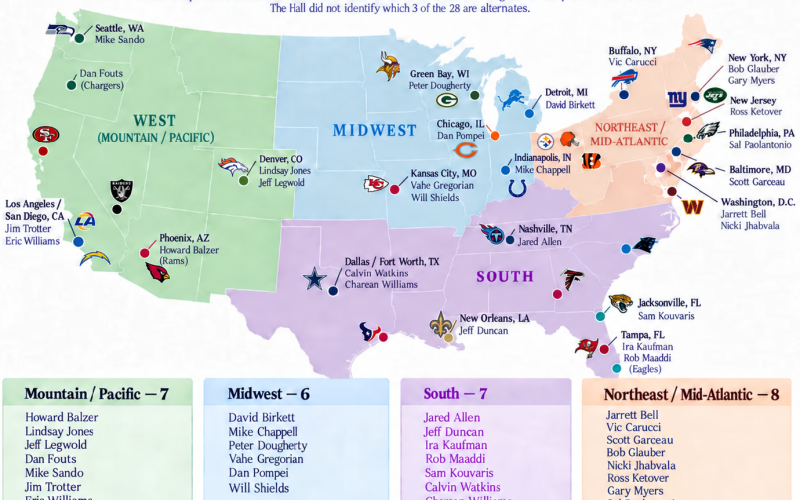
Official Results
Courtesy of Rich Desrosiers, HOF Chief Communications Officer
Earlier versions from shared information among selectors
Chart updated 10:30 a.m. PT Thursday
Click here for updated file
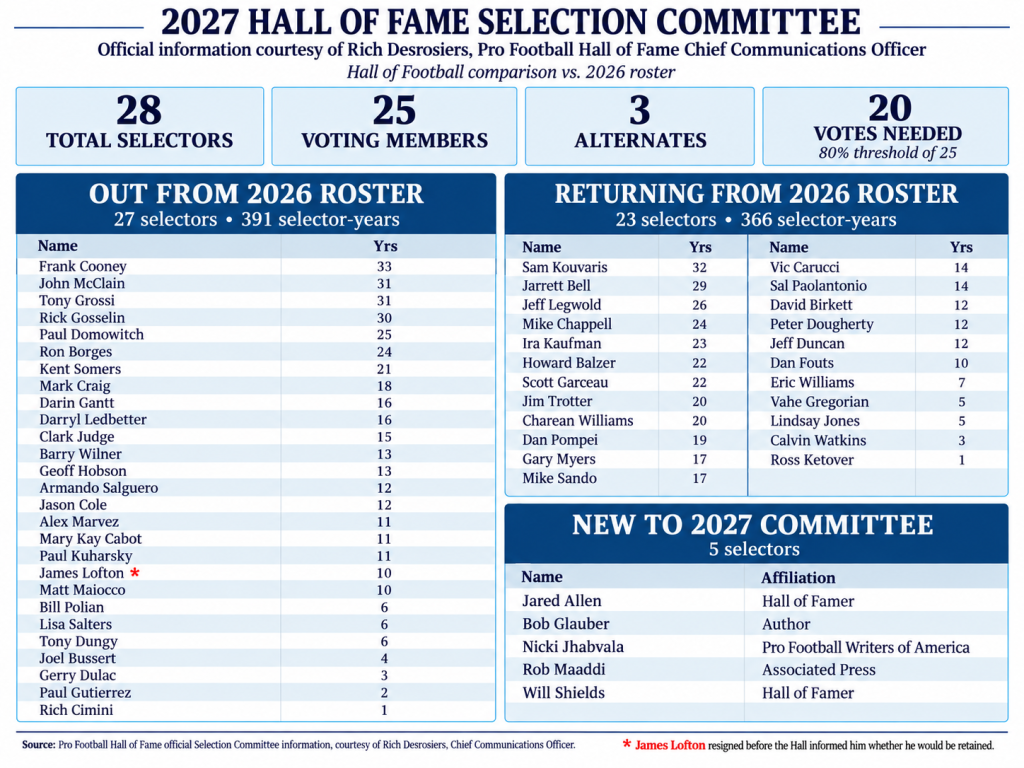
The reduction does more than change the number of chairs. It removes a substantial amount of accumulated Selection Committee experience at the same time the Hall is eliminating the structure specifically designed to help evaluate players from distant eras.
🏈🏈
As of 9 a.m. PT Thursday, Rich Desrosiers provided official information on the 2027 Pro Football Hall of Fame Selection Committee roster. The new committee consists of 28 selectors — 25 voting members and three alternates. Twenty votes are required for election, the 80-percent threshold of the 25 voters.
Comparison with the 2026 roster shows 27 selectors are out or resigned, representing 391 years of selector experience. Twenty-three return from the 2026 committee, representing 366 years of selector experience. Five members are new to the 2027 committee, and one, Bob Glauber, returns after retiring as a selector a few years ago.
Of those leaving the main committee, we know at least five accepted offers for new roles, probably as screeners. Although the Hall is not accounting for them, Hall of Football independently confirmed that at least seven declined offers for new roles and at least five were not offered another role, including me.
Earlier Thursday, Mark Craig (Minn.) informed us he served 18 years instead of the 14 listed by the Hall. He filled in for Sid Hartman and was a voter when Randall McDaniel was inducted in 2009, followed by John Randle in 2010 and Cris Carter in 2013. Great job, Mark. You will be missed as a selector and voter. Craig accepted a new role. I understand his situation. Although I am credited for 33 years, I actually filled in as a Raiders alternate at least one year.
We will continue updating information about new roles offered to former selectors as those details are confirmed.
🏈🏈
Experience alone does not make a selector right, nor should longevity guarantee a permanent seat. But institutional knowledge matters when the assignment includes judging players whose careers ended decades before many current voters began covering professional football.
Serving 33 years as a selector for the Pro Football Hall of Fame was an honor. After 61 years covering football — much of it evaluating players at all levels — I will continue to do my job.
But I am among many concerned about the future of the Pro Football Hall of Fame, including almost all those who were cut or resigned and some who were retained.
This is not about one selector or any group of selectors. It is about what the Pro Football Hall of Fame is becoming and, most important, how well the institution will preserve the history it exists to protect.
🏈🏈🏈🏈🏈🏈🏈🏈🏈
The rapid evolution to the Hall’s latest approach is shocking. In August 2024, the Seniors Blue-Ribbon Committee included nine members who averaged 18.6 years as Hall selectors and 47.2 years of involvement with the NFL. These selectors were hand-picked to evaluate seniors and nominate up to three as finalists.
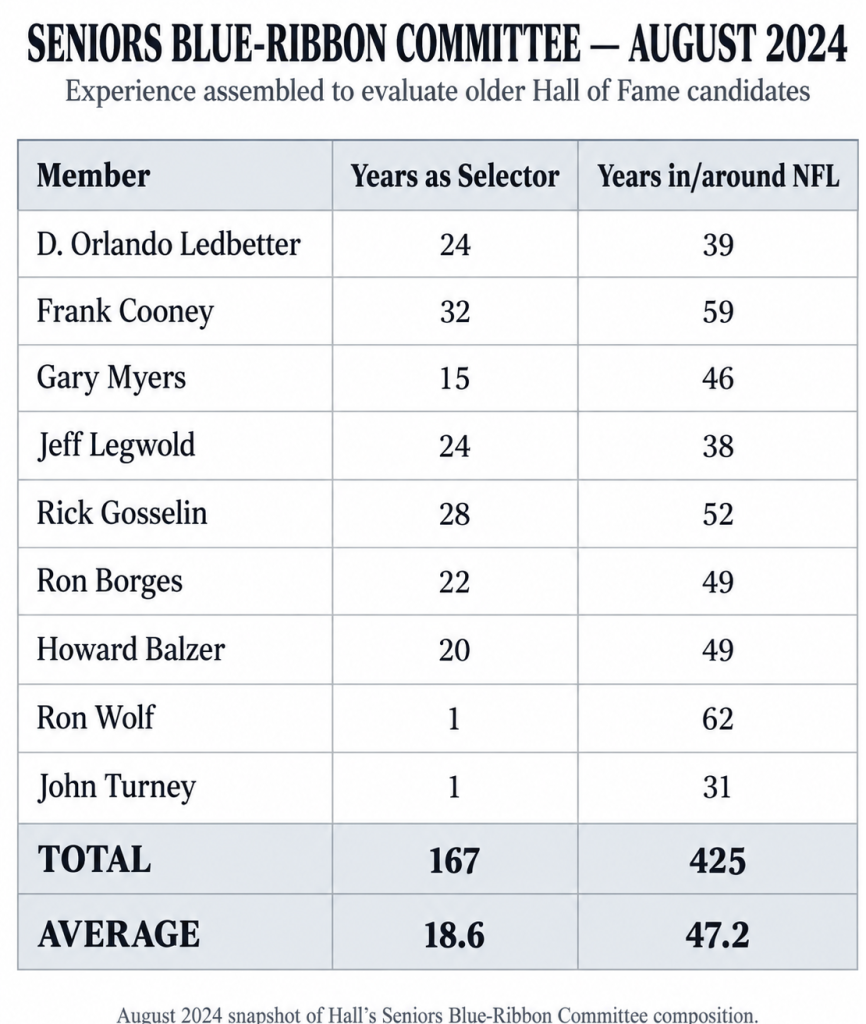
Less than two years later, that specialized committee — and the category it served — no longer exists. From that Blue Ribbon Senior Committee, Ledbetter, Cooney, Gosselin and Borges were cut from the overall committee. Wolf and Turney were senior advisors and we don’t know their role going forward.
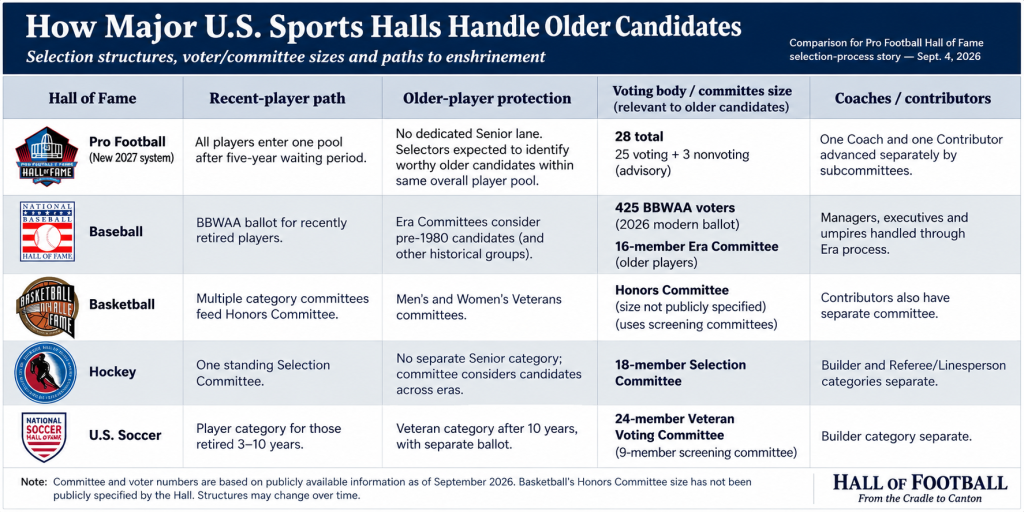
Now pro football is the only U. S. pro sport that doesn’t assist its historic heroes on whose shoulders the game were built.
🏈🏈🏈🏈🏈🏈🏈🏈🏈
“Seniors” had a lane since 1968
The Hall maintained a separate lane, in various forms, for Seniors to advance since 1968, when the process called for “up to two old-timers” to be voted upon separately and included among the seven inductees. The first Senior Committee nominated one Senior each year, although those candidates were not afforded a separate voting mechanism until 1975.
Starting in 2003, two Seniors could be among the finalists. In 2022, with a stated goal of bringing more historically overlooked candidates into the room, as many as three Seniors could advance as finalists.
All Hall of Fame player prospects now will reside in the same bucket. Gone is that 20-year window as a Modern-Era candidate followed by what we often called the Senior Abyss. Now everybody enters a bracket we might call Infinity — After five years of retirement a player is eligible for the Hall of Fame in perpetuity.
The danger, of course, is that although eligibility may be infinite, memory is not. As years pass, achievements fade from conversation, highlights disappear from television loops and newer stars arrive carrying fresher images and louder constituencies.
FWIW, when the Hall sent out requests for player nominees in July the letter began as usual by naming first-time eligibles for 2027. They included quarterbacks Cam Newton and Ben Roethlisberger, wide receiver Antonio Brown, tight end Rob Gronkowski, running back Adrian Peterson, offensive linemen Alex Mack (C) and Andrew Whitworth (T), defensive lineman Gerald McCoy (DT), and defensive backs Joe Haden, Malcolm Jenkins, Jason McCourty, Richard Sherman and Eric Weddle.
That should kick-start another year of recency bias.
🏈🏈🏈🏈🏈🏈🏈🏈🏈
This is the fourth time significant changes were made since Porter became Hall president in October 2021. Viewed in sequence, the alterations show little continuity of direction. Several conflict with earlier changes, including measures previously adopted to increase access for older players. Whether driven by outside reaction, internal reassessment or both, the process has repeatedly changed direction.
By far the most concerning element of the latest overhaul is the diminished status of older, overlooked players. They no longer have a dedicated path to rise above the celebratory, multimedia din surrounding more recent, better-known stars — precisely the environment in which recency bias can affect judgment.
Starting with the 2027 Class, unless the remaining selectors fundamentally alter how they evaluate and discuss older players, elimination of a dedicated Seniors path — which created as many as three finalists a year — will become the most consequential change in Hall of Fame history.
After the required five-year waiting period, every eligible player will compete from within one pool. After a series of cutdowns, the annual selection meeting will consider 13 players, plus one Coach and one Contributor.
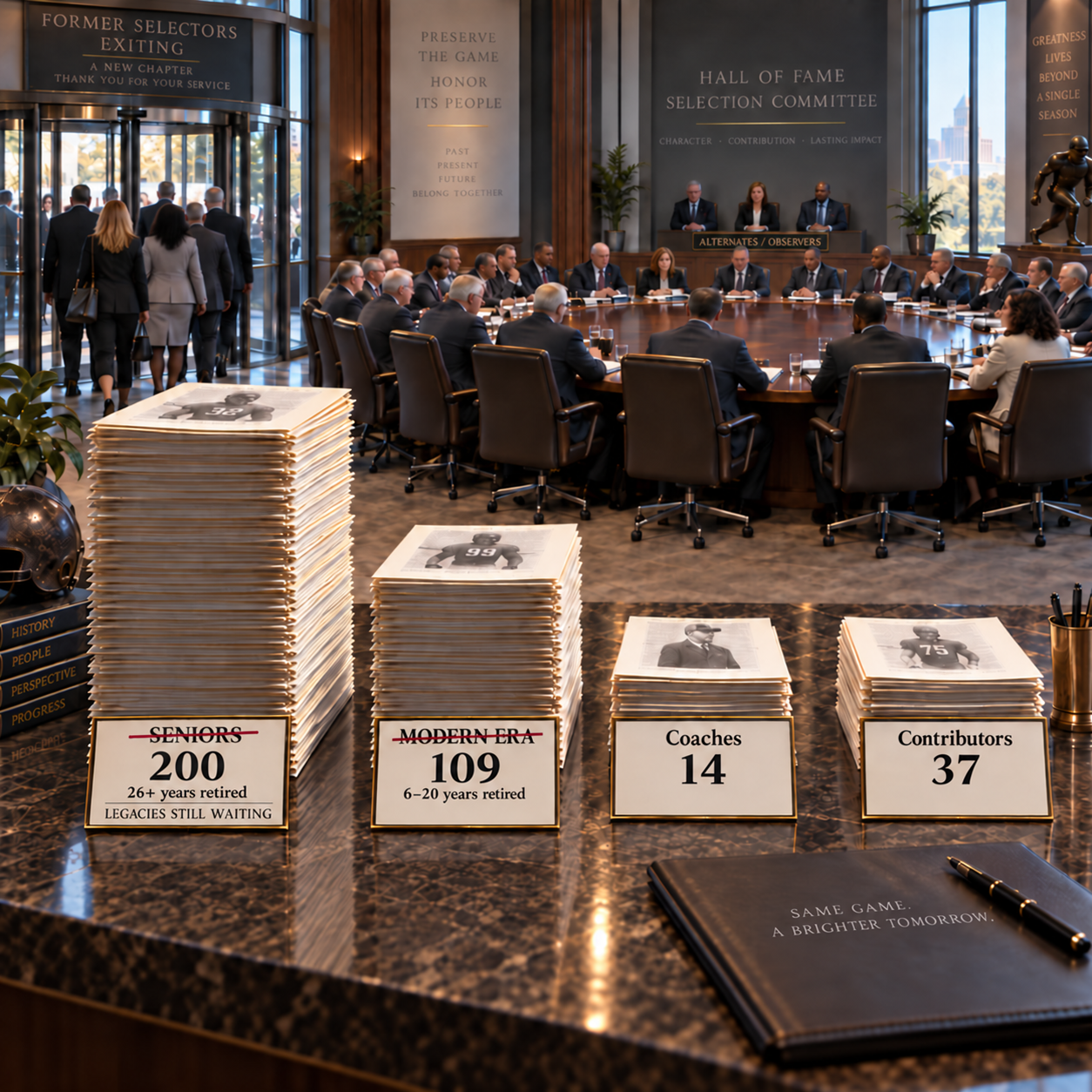
Committees to nominate finalists remain for Coaches and Contributors. This is curious because, based on nominees for the Class of 2027, candidates previously known as Seniors total 200 of the 309 player nominees. There were only 14 Coaches and 37 people loosely defined as Contributors. Yet Coaches and Contributors each retain a committee to facilitate getting at least one finalist into the room.
Go figure.
🏈🏈🏈🏈🏈🏈🏈🏈🏈
How did we get here?
The route hardly followed a straight line.
The Hall’s modern selection process first came under serious scrutiny with the Centennial Class of 2020. A special 25-member Blue-Ribbon panel selected 10 Senior players, three Contributors and two Coaches, while five Modern-Era players were chosen through the regular process. The stated purpose included addressing the historical backlog.
Porter became Hall president in 2021 and soon asked what the Hall was doing wrong. On Oct. 20, 2021, Porter was a guest on a podcast with veteran selectors Clark Judge and Ira Kaufman, who urged the new Hall president to increase the number of Seniors discussed. At the time, only one Senior could become a finalist through the Senior Committee.
“I want to know from our voters what we are doing wrong,” Porter replied.
Football historian John Turney answered publicly, pointing directly at the Senior backlog and arguing that older players needed more access, not less.
The Hall moved in that direction at first. The Classes of 2023 and 2024 elected five Seniors in two years. The Senior Committee increased its number of finalists from one to three, each of whom then needed only an 80-percent up-or-down vote for induction.
Then the Hall changed the process again, announcing another significant structural reset in August 2024.
For the Class of 2025, new Screening Committees and category-specific Blue-Ribbon Committees were created. Three Seniors still advanced to the final meeting, but they were placed in one voting group with a Coach and Contributor. Each selector could vote for only three of the five, while every candidate still needed 80 percent approval for election.
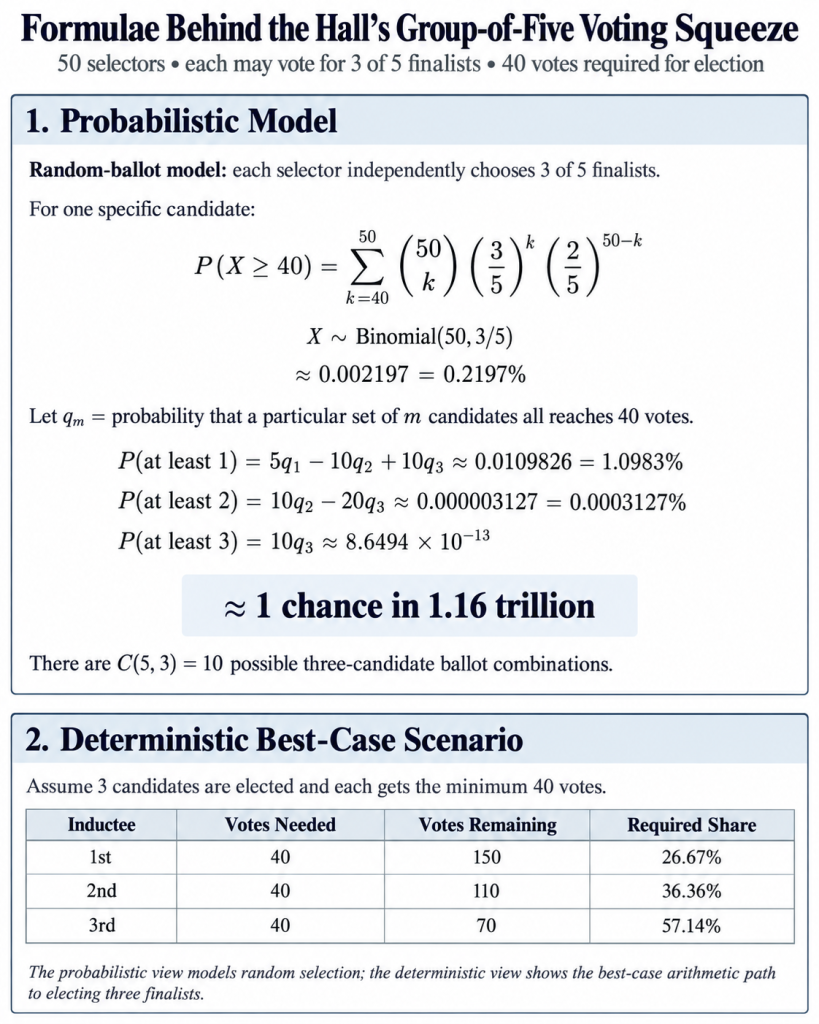
Therein lies the gazinta problem: five Hall-worthy candidates may go into the room, but only three can go onto any selector’s ballot. A voter who believed all five belonged in Canton was required to vote against two of them. The ballot no longer provided a simple up-or-down judgment on Hall worthiness; it forced different kinds of football résumés to compete against one another.
We questioned the mathematics before the system was used. The Hall’s response maintained that “we were told” the approach could result in two or three inductees from the Group of Five. While mathematically possible, I repeatedly argued that multiple inductions were far from probable.
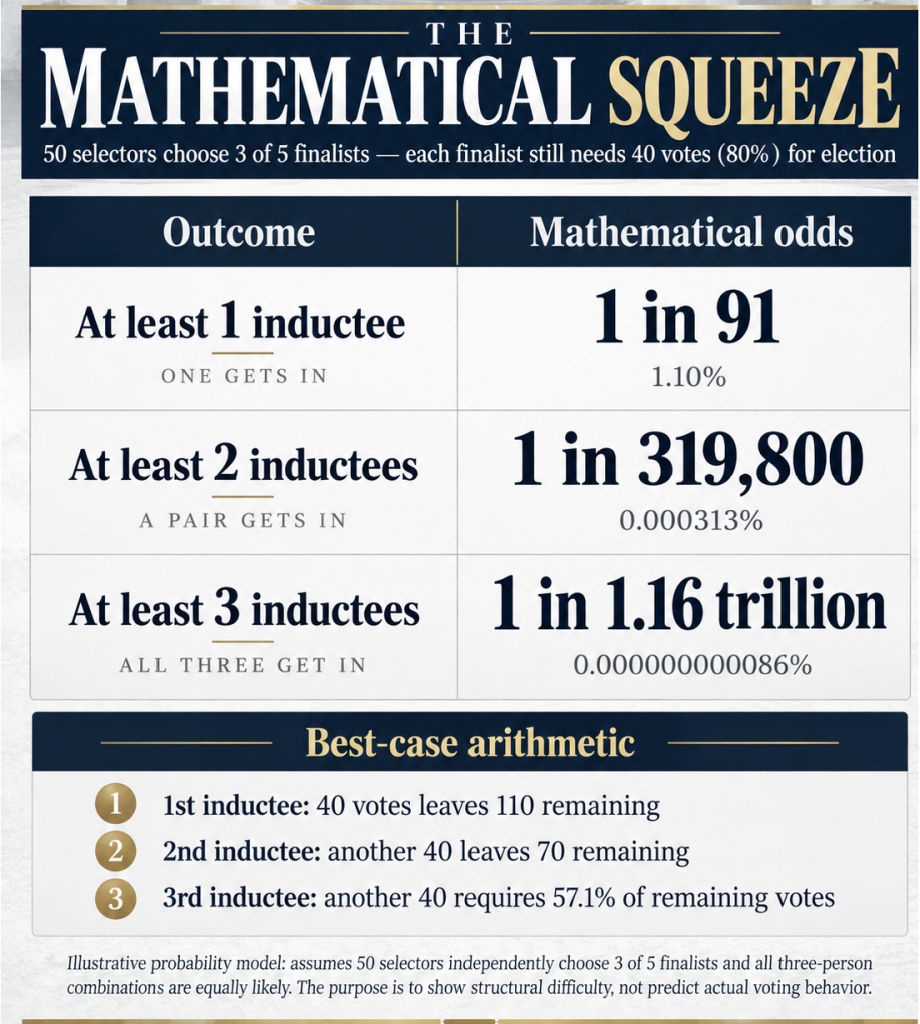
A formulae guide for all you DIY types:
So. …
In 2025, only Senior wide receiver Sterling Sharpe survived. Seniors Maxie Baughan and Jim Tyrer, Coach Mike Holmgren and Contributor Ralph Hay fell short.
One year might be dismissed as an aberration. In 2026, however, Senior Roger Craig was the only candidate elected from a group that also included Seniors Ken Anderson and L.C. Greenwood, Contributor Robert Kraft and, of course, Coach Belichick.
Over two classes, the combined groups produced two inductees from 10 finalists — both Seniors, with no Coach or Contributor elected.
The preceding four classes told a very different story. Between 2021 and 2024, 12 Seniors, Coaches and Contributors were inducted, including seven Seniors. The Classes of 2023 and 2024 alone elected five Seniors.
Then the structure changed. Three Seniors, one Coach and one Contributor were combined into a five-person voting group from which each selector could vote for only three, while every candidate still needed 80 percent approval. In the two classes conducted under that system, one Senior was elected each year. No Coach. No Contributor.
🏈🏈🏈🏈🏈🏈🏈🏈🏈
Summary of Inductions 2021-2026
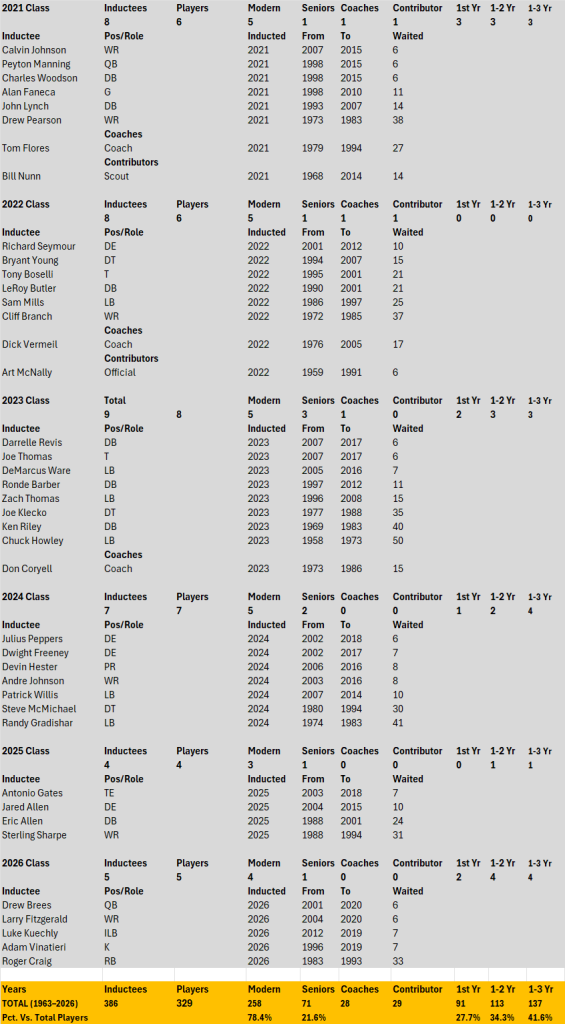
Belichick became the most conspicuous casualty. Under the previous up-or-down voting process, selectors could have judged his Hall worthiness independently. Under the Group of Five structure, a vote for one candidate necessarily meant withholding a vote from another.
Hours after announcement of the Class of 2026, Porter asked: “The question is, what changed?” (Hall of Football discussed this thoroughly as part of series on History, Mystery, Future of HOF).
Porter continued: “What was it that the selectors could do that for the 50-some years but now can’t? They could get the right person in that didn’t require a category… there’s a responsibility there. The responsibility is to pick the most deserving. They got down to where that number was. So my question is, is everybody picking the most deserving?”
With that, and other statements, Porter blamed the selectors, apparently for an unpopular result that failed to induct Belichick, although Porter was curiously vague in clarifying exactly what he meant.
Notably, four years earlier, Porter described the Hall’s objective, and selectors, very differently.
“Members of the Selection Committee have made it clear they wanted to get more Seniors ‘in the room’ for discussion,” he said when the Hall announced its 2022 changes. “From those initial conversations, the team at the Hall of Fame overseeing the Selection Process worked with the Board to create a path for those committee discussions that could lead to possible enshrinement for more Seniors.”
But by 2026, Porter had issues with selectors. He objected after to one selector acknowledging that he favored a Senior player over a Coach because the player might never return as a finalist while the Coach probably would.
“That’s not an option,” Porter said. “You have to pick the most deserving. Those are the instructions that were read four times.”
Maybe so, but the term “most deserving” does not appear in the bylaws. The substantive standard says the criteria for election are a nominee’s achievements and contributions as a Player, Coach or Contributor in professional football in the United States.
The selectors did not suddenly change. The voting structure did.
Yet after two classes under that structure, the Hall now changed course again — not by restoring the separate Senior vote, but by eliminating the dedicated Seniors category altogether.
The Hall says its revised bylaws followed a 2½-year comprehensive review involving staff members, Board members, Hall of Famers and Selection Committee members. Porter said previous rules could create “unintended biases,” including differences among presenters, team assignments for selectors and treatment of players nearing the end of Modern-Era eligibility.
While we debated the consequences of the 2024 change, lurking in the background for two years was the fact that this was setting up the infamous inability to induct Belichick in the 2026 Class, his first year of eligibility. Selectors blamed the process. Porter blamed the selectors.
Now it seems the Hall is overcompensating by eliminating help for the overburdened “senior abyss” while affording a shorter list of coaches and contributors a lane to induction that is mathematically inordinate
If all players now compete in one pool, chronology becomes more important, not less.
A player whose career ended in 1980 cannot be evaluated responsibly as if he retired in 2020. His statistics, honors, competition and positional responsibilities must be understood in the context of his era.
That becomes the responsibility of the remaining selectors.
I will continue to do my job and I hope they do theirs.
🏈🏈🏈🏈🏈🏈🏈🏈🏈