HOF Changes: Too many unanswered questions
Seniors get short shrift; 11 teams have no selector connection on 2027 committee
🏈🏈🏈🏈🏈🏈🏈🏈🏈
Click here for updates
🏈🏈🏈🏈🏈🏈🏈🏈🏈
When the Pro Football Hall of Fame shrunk the Selection Committee for 2027, it diminished underlying institutional DNA, erased the GPS and screwed with the numbers in a way it may not have considered.
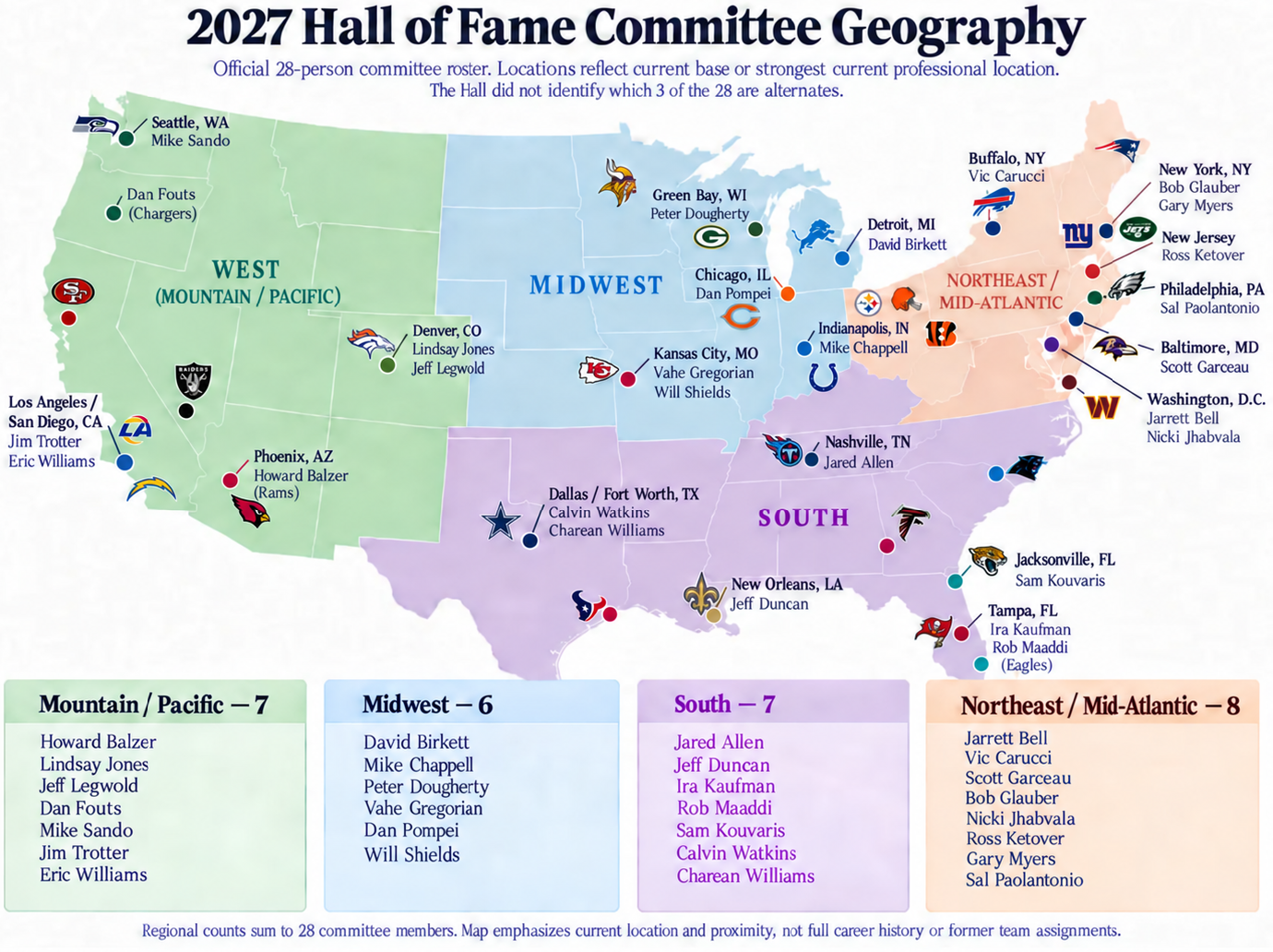
A look at our featured graphic of the United States gives you the picture — literally. Later we present charts that show specific levels of association between 32 teams and 28 selectors … and much more.
For decades, geography was built into the selection system. Each NFL franchise had a selector responsible for knowing that team, its history and the candidates who emerged from it. The Hall eliminated those assignments this year, reducing the committee from 50 members to 25 voting and three alternates, with everybody technically designated as At-Large.
There was some reasoning behind it, including that local reporters were no longer almost embedded with the teams. In fact, journalists are increasingly insulated by a series of rules alleged to protect players and coaches from actually getting to know the multimedia mob that covers them, now from afar.
This gave the Hall of Fame leverage to re-imagine the makeup of the Selection Committee for reasons that were never really explained. That last part is most bothersome considering HOF President Jim Porter paid lip service to the Hall being more transparent.
He first mentioned transparency in 2024, just before creating two screening committees of 11 each with seven Hall of Famers on each. Not only were the screeners anonymous, when I asked if I could send them a message as a member of the Blue Ribbon Senior Committee, the idea was rejected.
It would be nice if Porter explained the exact reasons for that and many other changes he initiated since taking office in 2021, some of them conflicting with each other. However, Porter chose not to communicate with me directly since October of 2025 when I requested an interview for a story on the status of the Hall of Fame.
My requests began long before the public outrage over the results of the 2026 Class and the reaction to Bill Belichick not being inducted. Porter ignored or rejected five written requests. He also blocked my emails. This after telling him I was writing the story — which became a series — with or without his input.
This was easily the rudest, or least professional, treatment I encountered in 61 years covering football. Even in the intense pre-merger days in the 1960s I talked with NFL Commissioner Pete Rozelle and then-AFL Commissioner Al Davis as many as three times a day. Had drinks with Rozelle. Dinner with Davis.
It remains unclear why Porter shut out the most tenured selector on the committee after 33 years working with the Hall and establishing great relationships with four previous HOF presidents. So, I wasn’t surprised to be among those cut without any specific explanation. I was honored to be a part of the HOF process, and I will miss it. But my work, including reporting on the Hall and prospects, will continue.
That brings us to an analysis of the handpicked 2027 Selection Committee. If Jim Porter unblocked his inbox, here are at least five hard facts and questions we would address about the most recent changes, in order of priority:
🏈🏈🏈🏈🏈🏈🏈🏈🏈
1. Erasure of NFL’s foundational players
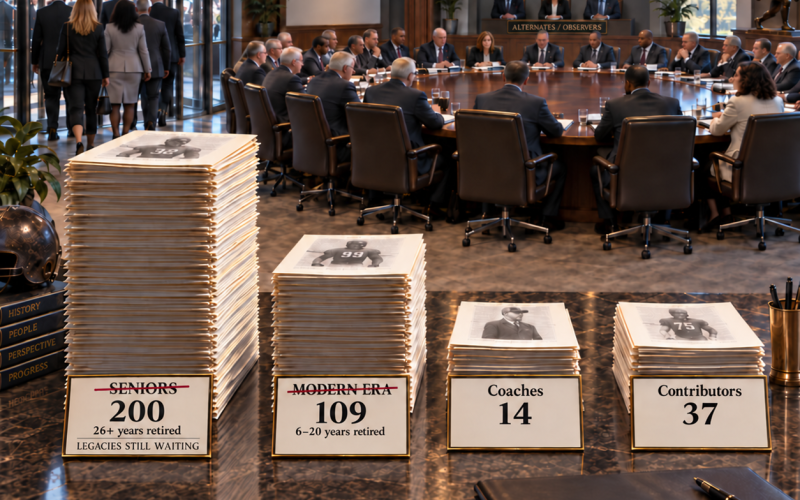
Look at the stark reality of the candidate stacks below. The mountain of cards on the far left represents 200 Senior candidates — men who played more than 26 years ago, whose sweat and broken bones built the foundation of the modern billion-dollar NFL. They played for pay so low they needed second and third jobs. They outnumber modern players nearly two to one, and completely dwarf the 14 coaches and 37 contributors.
What is the reason for eliminating a seniors committee and any path to enable selectors to help these old stars on whose shoulders the NFL was built? Nominees for the 2027 class included — again, worth repeating — 200 seniors, while coaches were 14 and contributors totaled 37, although most were unrealistic. How do 200 legends survive a process where they have no distinct lifeline?
🏈🏈🏈🏈🏈🏈🏈🏈🏈
2. Strategic gerrymandering?
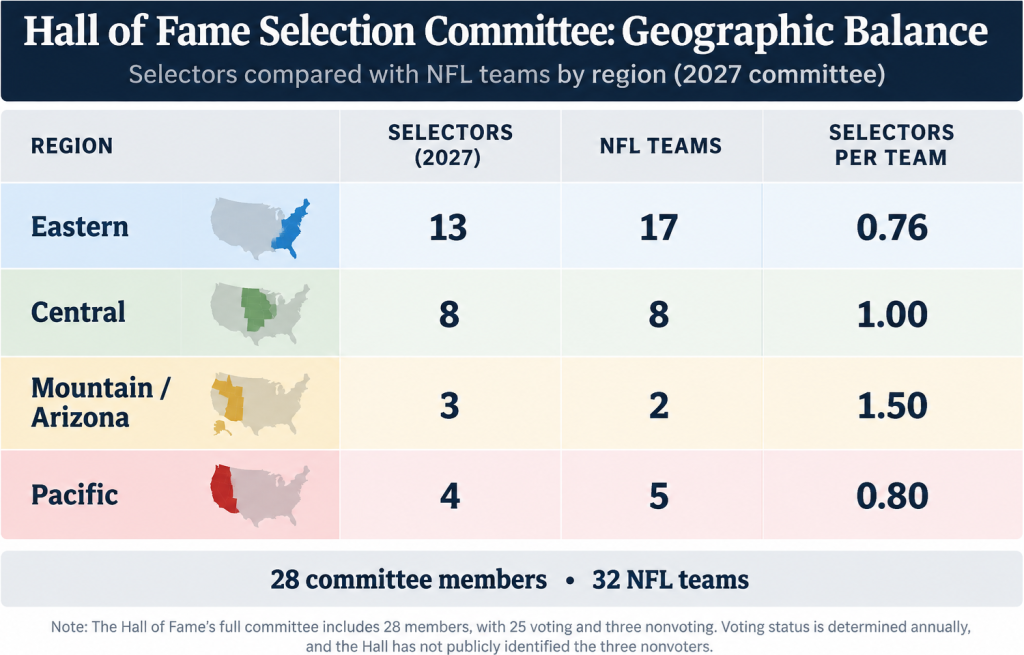
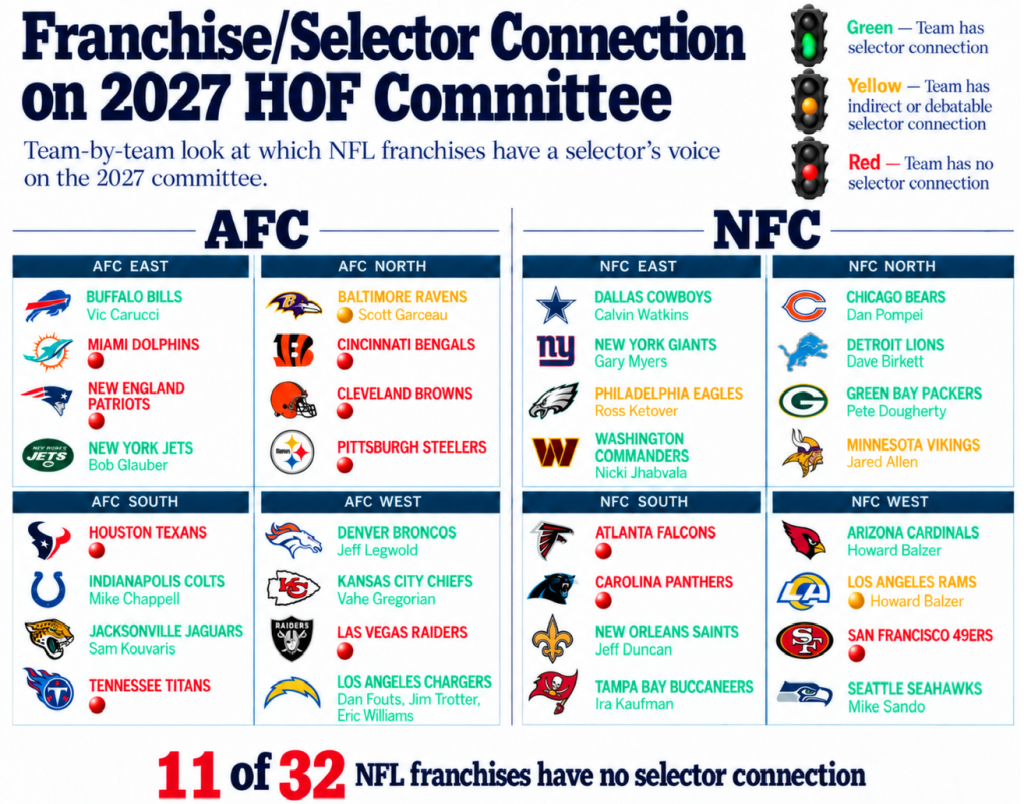
Our regional balance chart and national map expose a staggering geographic disparity that produces a geographic imbalance that invites questions about how the 28 were chosen. The Eastern region holds 13 selectors for 17 teams, meaning a massive 0.76 density. Yes that can be defended by the fact that so many teams are huddled together in that area. Still, the entire NFC East corridor is 100% represented with four out of four direct selector connections. Meanwhile, historic franchises in the AFC North like the Steelers, Browns and Bengals—along with iconic AFC brands like the Raiders—have zero voice on the committee.
What is the realistic expectation of eliminating market-based bias and regional advocacy? How can the Hall claim it is reducing regional bias when it completely blanks iconic football hotbeds while giving an entire division a permanent seat at the table? And is it a coincidence that the teams I mentioned are all from the AFC?
OK, I have deep roots in the AFC, but just because you are paranoid doesn’t mean that someone is not out to get you.
Furthermore, when you eliminate regional assignments, you erase institutional knowledge. If Eli Manning remains in the hunt and rides the wave of a fully represented Northeast media market, who is left in your shrunken-down room to advocate for Hall-worthy historical figures with similar championship credentials like Jim Plunkett? Without a dedicated selector, who fights the uphill battle for Lester Hayes, Steve Wisniewski or Jack Tatum? Yea, yea … I did represent the Raiders for 31 years on the selection committee before handing off to Paul Gutierrez, who was also cut. That doesn’t diminish the argument.
🏈🏈🏈🏈🏈🏈🏈🏈🏈
3. Weaponization of the six-vote veto
Why was the committee size reduced so drastically? Bylaws explicitly outlaw collusion and group-voting blocks, promising dismissal for anyone who coordinates a ballot. But history proved that a block of 12 or more selectors worked together to block former commissioner Paul Tagliabue for 13 years until the Hall created a handpicked Centennial Committee in 2020 and Tagliabue was inducted.
The Hall has a well-known history of aggressively policing the room when the establishment’s—meaning the NFL’s—preferred candidates are blocked. Look at what happened with Paul Tagliabue. Two of the most outspoken selectors against his induction, Ira Miller and Vito Stellino, were abruptly removed from the committee and told they “resigned” when they had done no such thing. Can you expect anyone to believe that a tiny 25-voter room with a six-vote blocking minority doesn’t create greater vulnerability to coordinated voting or entrenched blocs?
What will the Hall do when results aren’t what was expected? Or did we all just experience the answer to that one?
🏈🏈🏈🏈🏈🏈🏈🏈🏈
4. Subcommittee paradox; veteran purge
Using standard, data-based introductions for presenting candidates to the full committee is supposed to somehow lead to a more invigorating discussion. But in stripping the commitee down to 25, some of the most outspoken veteran selectors are no longer in the room, including Rick Gosselin, Ron Borges, John McClain, Clark Judge and others who were cut. I’ve been in far more selection committees than you, Jim, and these men were active, aware and aggressive in the room. What was your criteria on who was cut and who was kept?
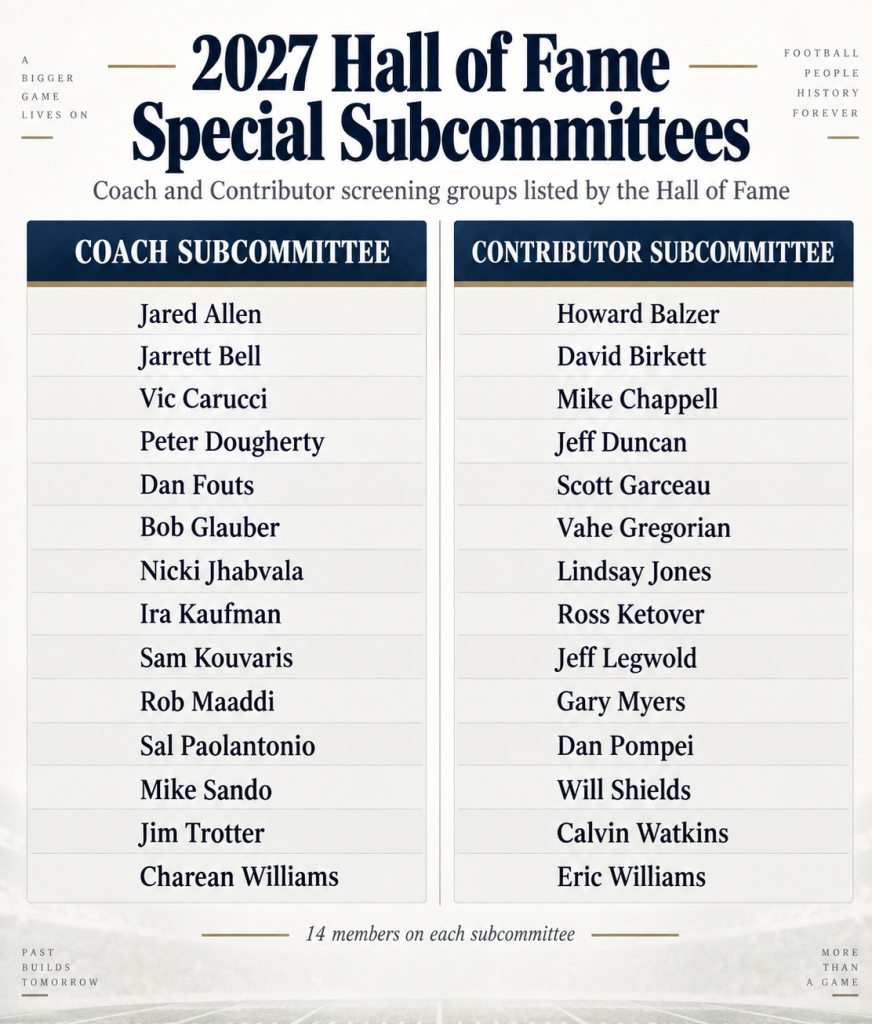
Now let’s look at the large rosters for the 2027 Coach and Contributor Special Subcommittees. The Hall expanded these groups to 14 members each, meaning Porter is utilizing all 28 committee members to painstakingly sort through a grand total of just 51 prospects — 14 coaches and 37 contributors, including many repeat nominees with no realistic chance.
Think about the upside-down priorities of that math: 28 selectors are assigned to micromanage 51 prospects, most of them fringe nominees at best. But the subcommittees will extract two finalists from those groups, while 200 senior legends get absolutely nada. This leaves football as the only U. S. pro sport that offers no help for the forgotten old stars that sustained the game.
🏈🏈🏈🏈🏈🏈🏈🏈🏈
By blocking my emails, Porter didn’t protect the integrity of the Hall of Fame; he just proved that the current leadership cannot defend its own math.
I talked to more than 30 selectors in the last two weeks and 26 are concerned about the direction the HOF is going, including Paul Domowitch.
When you shrink the room to 25 voters, eliminate built-in franchise representation, fold 200 former Seniors into the general player pool and remove many veteran selectors, you are not simply changing procedure. You are changing who gets heard, who gets remembered and how easily a small bloc can stop a candidate.
The voters may have been cut down, but questions remain, so the truth is elusive.