HOFame: History, Mystery, Future, Part IV
Part IV: Answering the question "What Changed?"

🏈🏈🏈🏈🏈🏈🏈🏈🏈🏈🏈🏈🏈🏈
Editor’s note: This is Part 4 of a five-part series on the evolution of the Pro Football Hall of Fame, from concept to completion and through the years to the current status. Written by Frank Cooney, in his 33rd year on the Hall of Fame selection committee. We also provide unique research, analysis and data to complement this series
*Access the full HOFame Reference post here.
Hall of Football is not affiliated with the Pro Football Hall of Fame. All analysis and opinions expressed are solely those of Hall of Football (HallofFootball.substack.com).
🏈🏈🏈🏈🏈🏈🏈🏈🏈🏈🏈🏈🏈🏈
“The question is, what changed?” Jim Porter asked hours after the announcement of the Class of 2026.
The President of the Pro Football Hall of Fame expanded his thoughts.
“What was it that the selectors could do that for the 50-some years but now can’t?” asked Porter. “They could get the right person in that didn’t require a category… there’s a responsibility there. The responsibility is to pick the most deserving. They got down to where that number was. So my question is, is everybody picking the most deserving?”
It did not land quietly.
Most public interest was driven by a bruhaha over former New England coach Bill Belichick not being inducted. But selectors were even more concerned with a broader consideration—a process that limited them.
What changed?
Go back just a few years and the process did not feel this way.
In 2022, the Hall responded to selector input to at least discuss more seniors, noting so many were former All-Decade players who were barely, or never, discussed during their 20 years as Modern Era candidates.
The result was a series of adjustments that appeared to open lanes—particularly for seniors—who had long been squeezed by the process.
🏈🏈🏈🏈🏈🏈🏈🏈🏈🏈🏈🏈🏈🏈
HOF 2022 rules announcement:
“Members of the Selection Committee have made it clear they wanted to get more Seniors ‘in the room’ for discussion,” said Pro Football Hall of Fame president Jim Porter. “From those initial conversations, the team at the Hall of Fame overseeing the Selection Process worked with the Board to create a path for those committee discussions that could lead to possible enshrinement for more Seniors.”
🏈🏈🏈🏈🏈🏈🏈🏈🏈🏈🏈🏈🏈🏈
Perhaps the most interesting line was that Porter acknowledged input from the selectors, many of whom were on the committee for decades. It felt like a team pulling together for a common goal.
That did not last.
By the summer of 2024, the tone shifted. First in small ways.
In July, selectors were asked to confirm whether they intended to remain on the committee, with a next-day deadline to respond. They were also told the Hall was “working on ways a selector could stay involved in the process in a different manner.”
Veteran selectors had not seen communication like that before, particularly with such a short turnaround, and were unsure what was driving it.
What changed?
In mid-August 2024, selectors were told for the second time in two years that “significant changes” to the selection process were coming.
These changes were not the result of input from selectors. Committee structures would be reshaped. Categories would be adjusted. The process would move in a different direction. Several selectors said they had not been part of shaping the changes and did not know others who were. They were left to react after the fact.
Days later, the Hall made those changes public, describing a system designed to ensure the Hall remained “elite” while bringing “fresh perspectives” to the discussion of candidates. “The goal is to continue to elect great classes while maintaining the integrity of the process,” Rich Desrosiers said at the time.
Most selectors did not see how the changes would address such a goal, which was itself vague at best.
🏈🏈🏈🏈🏈🏈🏈🏈🏈🏈🏈🏈🏈🏈
Specifics followed, summed up here:
— Two new, 11-person Screening Committees, which included Hall of Famers, to screen the full lists of nominees in the Modern-Era Players and Seniors categories separately before the lists moved to their Blue Ribbon Committees.
— A revamped Seniors Blue-Ribbon Committee, composed of of nine individuals (down from 12)—seven who also are members of the full Selection Committee and two others who will hold full voting rights for this subcommittee only.
— A change in the waiting period for coach candidates, reduced from five seasons out of the game to one season. (No waiting period exists for contributor candidates.) And, no, Bill Belichick is not eligible until the 2026 Class.
— A new process. Through a sequence of reduction votes over several weeks, the Coach Blue-Ribbon Committee and the Contributor Blue-Ribbon Committee will select one finalist each for the Class of 2025 and, using the same process, the Seniors Blue-Ribbon Committee will select three finalists.
— A new reduction process: The five finalists from the Seniors, Coach and Contributor categories will be combined into a single group for voting by selectors. No more than three nor fewer than one may be elected. As with the Modern-Era Players, approval from 80 percent of the selectors is required for election.
🏈🏈🏈🏈🏈🏈🏈🏈🏈🏈🏈🏈🏈🏈
First there was the addition of two upstream anonymous, 11-person screening committees. Veteran selectors wondered how the words anonymous and integrtity fit together in the new protocal puzzle.
Under the revised process, seniors, coaches and contributors are grouped together into a single pool of finalists, as chosen by their respective Blue Ribbon subcommittees.
Selectors dubbed it the “group of five”—three senior players, a coach and a contributor. Each member of the 50-person selection committee could cast three votes, for a total of 150; induction required 80 percent, or 40 votes.
Said one selector of the “group of five” voting: “It is troublesome. To borrow a cliché, it is like comparing apples and kumquats to aardvarks and cigars.” After the new rules were announced, we discussed that challenge in the Hall of Football.
The modern-era process was also adjusted. Fifteen finalists would be reduced to ten, then seven. From there, selectors would vote for five, with only those reaching 80 percent assured of election, and a minimum of three and maximum of five allowed.
After considering the new directives, many selectors discussed potential consequences.
What changed?
In each of the next two cycles, fewer than five modern-era candidates were elected. Coaches remained outside. Candidates who once advanced along separate tracks were now competing head-to-head.
The backlog did not clear.
It rolled forward.
Most selectors said the new process made it more difficult for candidates to advance, particularly those outside the modern-era pipeline—seniors, coaches and contributors.
🏈🏈🏈🏈🏈🏈🏈🏈🏈
HOF class breakdowns 2021 to 2026
Notice class sizes were from seven to nine inductees until after 2024 rules change that impacted classes in 2025 and 2026.
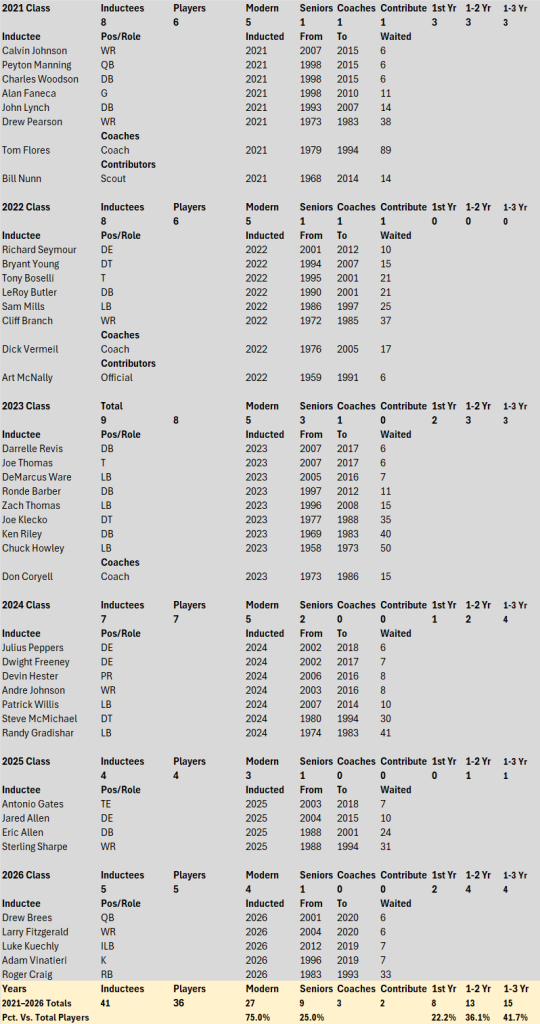
See complete list and list compressed by decades in our research section
🏈🏈🏈🏈🏈🏈🏈🏈🏈
What changed?
In the hours leading up to the announcement of the Class of 2026, the tenor of the process, the relationship with the Hall of Fame, shifted for selectors.
A release issued by Rich Desrosiers addressed the role of selectors before the class itself was revealed. The emphasis, several selectors noted, was not on the candidates but on those casting the votes, an about face from the message during the rules changes in 2022. .
🏈🏈🏈🏈🏈🏈🏈🏈🏈🏈🏈🏈
Statement on media reports related to Hall of Fame Class of 2026
The Pro Football Hall of Fame understands and respects the passionate reaction of many fans, media members and enshrinees of the Hall itself in light of published reports regarding the voting results for the Class of 2026.
It’s that very passion that propels the game.
The Hall also respects the members of the Selection Committee when they follow the selection process bylaws. It is an honor to serve as a selector.
Each year, the Hall reviews the selection process and the composition of the 50-person Selection Committee. If it is determined that any member(s) violated the selection process bylaws, they understand action will be taken.
That could include the possibility that such selector(s) would not remain a member of the committee moving forward.
The selection of a new class is the most important duty the Hall of Fame oversees each year, and the integrity of that process cannot be in question.
== by Rich Desrosiers, Chief Communications & Content Officer
🏈🏈🏈🏈🏈🏈🏈🏈🏈🏈🏈🏈
What changed?
Let’s ignore for a moment that in 2022 and 2024 the Hall itself announced what it labeled as “significant changes.” When the 2026 class was announced, Porter dismissed procedural changes and mentioned the selectors.
He pointed to a processes that had produced larger classes for more than a decade and suggested the recent contraction reflected the choices being made within it. He failed the mention those were different processes.
Going forward, he said there would be tweaks, but not an overhaul. The responsibility, as he framed it, remained with the selectors to abide by the rules and identify the most deserving candidates and follow the rules as written.
Selectors mulled the what rules may have been violated and questioned the meaning of “most deserving.”
What changed?
For some selectors, the message was clear.
“I think we have been thrown under the bus,” said one selector.
Another said the reaction from the Hall felt less like an explanation and more like a deflection.
What changed?
Let’s look back several years to expand context—perhaps even offer a harbinger of what became more obvious in 2026 under the harsh glare of Belichick failing to become a first ballot inductee.
Consider Paul Tagliabue, the former NFL Commissioner from 1989 to 2006. His candidacy was a hot-button issue for more than a decade. Again, some feel selectors took the hit when his induction was delayed. Ask former selectors Ira Miller and Vito Stellino.
He was on the preliminary list a couple of years earler, but Tagliabue became eligible in 2007. He was not elected until 2020, under special circumstances.
There were reasons. They were debated inside the room and, at times, outside it. Among those raising questions were the late Paul Zimmerman, along with former veteran selectors Miller and Stellino. Zimmerman was incapacitated by a series of strokes in 2008 and died in 2018. The debate did not end with his departure.
Tagliabue’s candidacy was not about statistics or championships. It centered on decisions made during his tenure—most notably the league’s response to head injuries.
Critics pointed to the creation of the Mild Traumatic Brain Injury Committee, the league’s early public stance minimizing concussions, and the decision to place a rheumatologist with no expertise in head injuries in charge of the panel. As the Associated Press noted at the time, Tagliabue was “on the wrong side of what would become the biggest issue facing the league.”
At the time, Tagliabue dismissed the issue as “one of those pack journalism issues.” Years later, he would say, “I do regret those remarks.”
Inside the room, those decisions were part of the record. Selectors debated not just what Tagliabue accomplished, but how those significant financial increases should be weighed within his total body of work.
In 2013, Miller and Stellino were informed by then Hall president David Baker that they were being replaced. It was announced they retired, which they vociferously denied.
Years passed. The issue did not disappear.
In 2020, the Hall created the Centennial Class Selection Committee and 20 inductees were selected through a separate track. At one point, selectors were told they would vote on the group as a whole; that approach changed after objections and inductions were individual.
Stellino believes the whole Centennial Committee “was as setup to get Tagliabue inducted.” Several selectors viewed the process as bypassing the traditional path, even as it produced results that eluded years of debate. Some selectors were leery about an original plan to vote inductees as a group, believing this was an attempt to package somebody who might not make it on his own. The group plan was trashed, but the reconstituted selection committee did its job.
Tagliabue’s bust now sits in Canton.
What changed?
By 2026, the question was no longer confined to the room.
The reaction did not stay inside the process. It spread quickly—across broadcasts, columns and social media—where the omission of Belichick was framed as an obvious oversight. A six-time Super Bowl-winning head coach, his absence from the class was viewed by many outside the process as indefensible.
Inside the room, the discussion was different, drawing on other elements, the same as happened to Tagliabue. There were important issues beyond a half dozen Lombardi Trophies.
Selectors, bound by the structure put in place in 2024, were weighing candidates across categories in ways that did not always align with public expectation. In years past that impacted Tagliabue and others. Were there similar considerations for Belichick?
What changed?
The question was asked inside the room. It was asked outside the room.
Porter posed the question in that interview hours after the 2026 class was announced.
The structure changed. The results followed. The reaction went public.
The selectors and the Hall were no longer aligned. The Hall, through Porter and Desrosiers, hinted the selectors were somehow at fault and changes may be made on the selection committee.
The divide did not need to be declared.
It was already there.
Next: Part V, Postscript — Addressing the future.
🏈🏈🏈🏈🏈🏈🏈🏈🏈