Hall of Fame at Critical Juncture, Part V
Part V: We sit in abeyance, awaiting next call from the Hall

🏈🏈🏈🏈🏈🏈🏈🏈🏈🏈🏈🏈🏈🏈
Editor’s note: This is the final part of a five-part series on the evolution of the Pro Football Hall of Fame, from concept to completion and through the years to the current status. Written by Frank Cooney, in his 33rd year on the Hall of Fame selection committee. We also provide unique research, analysis and data to complement this series and become a valuable part of your library.
*Access the full HOFame Reference post here.
Hall of Football is not affiliated with the Pro Football Hall of Fame. All analysis and opinions expressed are solely those of Hall of Football (HallofFootball.substack.com).
🏈🏈🏈🏈🏈🏈🏈🏈🏈🏈🏈🏈🏈🏈
As the Pro Football Hall of Fame turns toward the Class of 2027, acrimony between selectors and Hall administration is at an all-time high.
At the center of the divide is a simple disagreement:
Selectors believe current rules restrict their ability to make independent judgments and that controls results.
Hall president Jim Porter suggested the issue lies with the selectors rather than the process itself and said so in interviews the evening the 2026 Class was revealed.
“He threw us under the bus,” remarked one angered selector.
The split exploded into public view with reaction to the Class of 2026, which did not include Bill Belichick. His absence may stand on its own considerations, but it cannot be separated from the structure that produced it.
In the aftermath, the Hall convened a Zoom meeting with selectors in February to discuss concerns—90 minutes in the middle of the busiest day at the NFL Combine.
We now sit in abeyance, awaiting the Hall’s next move. After noting selector input during the February Zoom meeting, Porter will discuss several scenarios with consultants and then take a recommendation to the Board of Directors.
Among considerations is a change in the selection committee that may result in fewer selectors, but discussions will continue in June and the recommendation will go to the BOD in August.
There have been two “significant changes” to the Hall of Fame selection process since 2022, each emerging from pressure surrounding the system itself. After Jim Porter became Hall president in 2021, the Hall revised the rules in 2022 following complaints from selectors who wanted more senior candidates meaningfully discussed. The resulting two classes — 2022 and 2023 — produced 19 inducted players, including four seniors.
Then, in August of 2024, shortly after impromptu input from Hall of Famers during Enshrinement Week, the Hall announced the most sweeping rules changes in selection history. The next two classes — 2025 and 2026 — produced only seven modern-era inductees and two seniors combined. Things took on a life of their own when Bill Belichick failed to become a first-ballot inductee, triggering massive reaction from the public, media and social media.
Months earlier, before everything reached a fevered pitch, I surveyed selectors regarding the new process. Thirty responded. Twenty-six expressed dissatisfaction with the 2024 changes, while 19 said they considered stepping away from the committee if changes were not made.
We requested an interview with Jim Porter five times, beginning in October 2025 and most recently on March 23. He did not respond. We would have preferred to address these issues directly with his input. Maybe another time.
As pointed out earlier in this series, Porter framed the issue himself amidst strong public reaction the night the 2026 Class was revealed: “The question is, what’s changed?” he said.
“What was it that the selectors could do for 50-some years that they now can’t?” he asked. “They could get the right person in… The responsibility is to pick the most deserving… So my question is, is everybody picking the most deserving?”
Despite the unqualified phrase “most deserving,” it is a fair question. But it points in the wrong direction.
The selectors did not change. The system did.
In 2022 and again in 2024, the Hall introduced what it described as significant changes to the selection process—altering how finalists are grouped, how votes are cast, and how outcomes are constrained. Selectors were in the discussion for the 2022 changes, but as a group they were blind-sided by the new rules in 2024.
Those changes did not adjust the standard. They altered the path to meeting it.
Selectors raised concerns immediately that the new structure would reduce the number of candidates who could realistically be elected. The group of five finalists — three senior players, one coach and one contributor — were voted on head-to-head with 50 selectors getting three votes. To be inducted from that group, a candidate needed 80 percent, or 40 votes.
“Not only does the math make it problematic to induct anyone,” one selector said, “It is a troublesome ask. …it is like comparing apples and kumquats to arrdvaks and cigars.”
After the August 2024 changes, the Hall repeatedly assured concerned selectors it was told that the process could still yield multiple inductees. Told by whom? The math suggests otherwise.
This chart is based on the best case scenario of those inducted getting the minimum 40 votes.
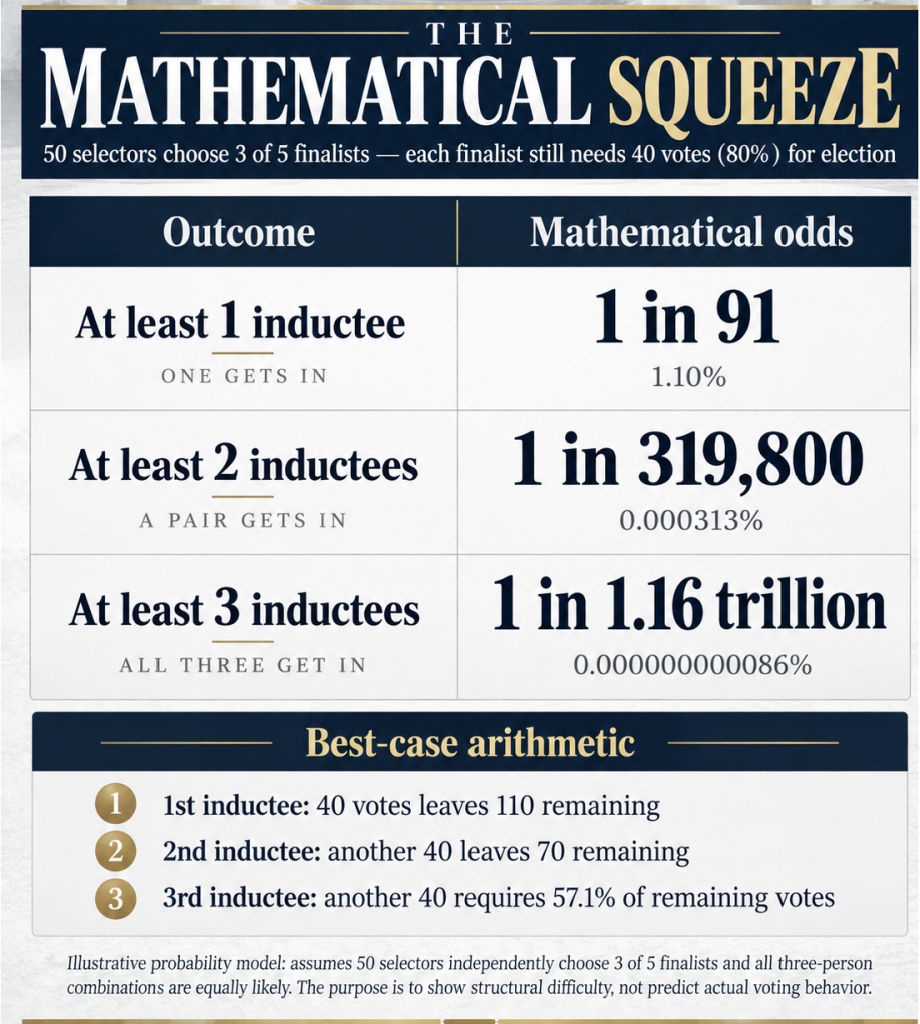
Even under the most favorable assumptions, the odds of inducting three are astronomical, with chance of .000000000086 percent, or 1 in 1.16 trillion.
The structure does not produce results. It restricts them.
The effect is not theoretical. It shows up in the results.
Overall, when the path to a Gold Jacket narrows, the first candidates through it are almost always the most recent. Established names with the most recent visibility move to the front, while older candidates—already on the margins—are pushed further back.
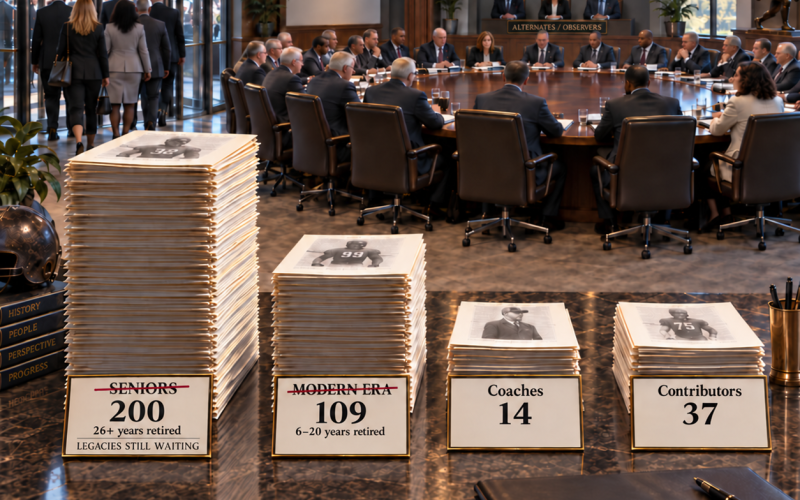
The result is a growing backlog of senior candidates — not because they lack merit, but because the structure favors immediacy over history.
Some question how a player can spend 20 years in the Modern Era pool with limited traction, then suddenly emerge as a finalist or inductee only in his final years of eligibility. It is recency bias, played out annually.
First-year eligibles arrive as the new stars of the conversation. They account for nearly 28 percent of all player inductees in their first year of eligibility and more than 34 percent within their first two years. Then another wave arrives and the cycle repeats.
The Hall’s own history shows the pattern: more than 41 percent of player inductees were elected within their first three years of eligibility.
Others slowly drift backward, surviving largely through the persistence of individual advocates. Wide receiver Torry Holt has become the face of the current pushback club. Eligible since 2015, Holt reached the finalist stage for the seventh time during the 2026 process, only to watch wide receiver Larry Fitzgerald inducted as a first-year ballot candidate.
At least Holt reached the room. Guard Steve Wisniewski never did, despite being an All-Decade selection with eight first- or second-team All-Pro honors before eventually sliding into the senior pool.
Since 2021, only two players were rescued from that Senior Abyss during their final years of Modern Era eligibility — Sam Mills in 2022 and Eric Allen in 2025.
The pressure only intensifies. In 2027, Holt enters his 13th year of eligibility while a new class arrives led by Adrian Peterson, Rob Gronkowski, Ben Roethlisberger, Richard Sherman, Cam Newton, Andrew Whitworth and Antonio Brown. In 2028 comes A. J. Green, J. J. Watt, Matt Ryan — and another quarterback known as Tom Brady.
This is how Hall of Fame-worthy candidates slide backward year after year until they eventually disappear into the senior pool.

What must change
First, identify who is in charge. Then identify a goal and maintain a consistent path toward it.
The current structure places enormous influence in the hands of the Hall president and his circle of advisers, who shape proposals before they reach the Board of Directors.
The last two major process changes revealed uncertainty, either in the chain of authority, the purpose behind it or both.
The Hall already possesses one of its most valuable resources for improving the process: the selectors themselves. They confront the realities, limitations and unintended consequences of the system every year.
Before major procedural changes are implemented, a rotating and transparent advisory group drawn from the Selection Committee should provide early input and practical evaluation of proposed reforms. That input should help shape the process before recommendations reach the Board of Directors — not after changes are already announced.
🏈🏈
Selectors must have the ability to select.
That becomes impossible when the Hall attempts to legislate outcomes through restrictive rules.
The process in which finalists are identified by category and evaluated independently must return. Blue Ribbon committees should identify the finalists — three senior players, one coach and one contributor. The full Selection Committee should then evaluate each finalist individually with a simple thumbs-up or thumbs-down vote, requiring 80 percent approval for election.
That approach worked in the final class before the 2024 rules change, when the full committee rejected both a senior candidate and a coach candidate.
Remove Structural Distortions
Senior players, coaches and contributors are distinctly different categories and should be evaluated independently.
A process that determines induction into the Hall of Fame must be accountable. If screening committees remain part of the process, they should not operate anonymously and should interact directly with the full Selection Committee.
Strengthen the Selection Committee
Times have changed since the earliest selectors were well-connected beat writers for local newspapers. NFL teams increasingly insulate players and coaches from the media, while newspapers continue to fade.
Each franchise should still have a selector deeply familiar with that organization’s ownership, coaches and players. But the broader emphasis should be on football knowledge, evaluation ability and historical perspective.
Selectors should possess demonstrable knowledge of the game and its history. Minimum standards for experience or expertise should exist to ensure informed evaluation across eras.
If Hall of Famers are included in the process, ensure they can evaluate beyond their own teammates, opponents and era. Most players know primarily the people and teams connected to their own careers, usually spanning little more than a decade. Some Hall of Famers, however, possess broader historical perspective through long careers in coaching, scouting, broadcasting or league involvement.
Find them.
Enforce Standards
If rules state that off-field considerations are excluded, clearly define those standards and apply them consistently. If a selector publicly declares a predetermined vote, recuse the selector from that candidate’s discussion and vote, with voting percentages adjusted accordingly.
This issue most recently surfaced during consideration of offensive tackle Jim Tyrer.
If such declarations are permitted without consequence, the rule itself becomes meaningless and the Hall becomes complicit in violating its own standards.
Consider Limited Transparency
Disclose vote totals to selectors for each finalist without revealing how individual selectors voted.
That would give selectors context from class to class and allow observers to better understand long-term trends, while still preserving the integrity and confidentiality of the discussion process.
🏈🏈🏈🏈🏈🏈🏈🏈🏈
From the 1960s, when Pete Rozelle helped shape pro football into a national institution alongside a country seeking common purpose under John F. Kennedy, the Hall of Fame reflected the era it inhabits.
What it reflects has not changed.
It still mirrors the country and the moment.
The moment itself has changed.
It is now a country divided.
The reaction to the Class of 2026 made that clear — reaching beyond football, turning a closed process into a public forum and leaving a divided Hall mirroring a divided country.
The question is no longer what changed.
The question is, what comes next?
Whether the Hall continues to reflect and preserve the history of the game — or becomes another institution shaped more by the moment — will depend on the choices it makes next.